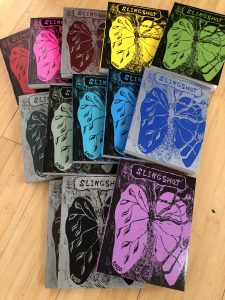
2- To our incarcerated subscribers

What we do: We provide free subscriptions to incarcerated individuals in the US who request them. Note that Slingshot only gets published 2-4 times a year so there will probably be a delay of some months between when you write us and when you get the paper. If you will only be at your current location for less than 3 months, it probably doesn’t make sense to write.

We accept submissions of art and articles from incarcerated subscribers. We don’t publish poetry or fiction, and only run personal narratives or stories about your case if they are framed within radical analysis. We can only publish a fraction of what we receive.

What we don’t do: we are unable to provide penpals, legal aid/advice, financial assistance, literature besides Slingshot, or respond to requests for other kinds of help. Usually, we can’t even personally write you back, though we read your words and appreciate the thoughts and stories you share. We cannot use JPay or other inmate email services. Unless otherwise noted, the addresses associated with zines we review or radical spaces listed are unlikely to be able to respond to prisoner correspondence.

Other resources: Folks inside get a free resource guide from Prison Activist Resource Center PO Box 70447 Oakland, CA 94612.

Comrades on the outside: We receive 5-10 letters from incarcerated folks every day. We welcome help reading this mountain of mail and processing subscription requests!

1- The grief of gentrification

By Gnat

“Fuck this city”. My best friend of twelve years, Luz, is full of rage at our hometown. Her family lived in a small apartment in the Mission district of San Francisco and their landlord sued them, claiming their belongings were a “fire hazard”. They contacted Causa Justa and San Francisco Tenants Union for help. Two months after a furious clean-up effort was underway, they lost the case and were evicted from their home of 36 years.

Prior to the trial, Luz had attempted suicide and her therapist advised her to stay in the psychiatric ward. When I found out on Halloween night, I broke down crying. Many of Luz’s friends and working-class neighbors are being systematically displaced. In the Mission, the diaspora of Chicano, Caribbean, Central and South American immigrants came in the mid-20th century and revitalized the spirit of the city before gentrification. Luz’s family holds strong roots: her father teaches music classes at the Mission Cultural Center, her mother knows all the church ladies, and she and her brother frequent flea markets to support their resale business at conventions.

We were both born and raised in this city. We’ve been involved in each other’s cultural backgrounds since we met in high school. She signs up every year to be a vendor at my synagogue’s Hanukkah Crafts Fair, enjoying tchotchkes like the “Mensch on a Bench” while we sell a variety of handmade gifts. We would volunteer together during Dia de los Muertos at the cultural center, passing out cinnamon hot chocolate mixed with corn husks, and breads shaped like skeletons. Her dad calls me, “my second daughter”. It makes me very sad to imagine their family gone from the Mission.

What has happened to San Francisco? My generation is living with our parents, or splitting rent amongst many roommates while working two jobs. We are the lucky ones. There are many more, California locals, who are living out of vans, wooden shelters and tents on the street, battling the elements and a society who wishes they disappeared. This city and its prosperous neighbors, Oakland and Berkeley, prefer to sweep the blocks, destroying belongings, acting like the homeless should be criminalized for their state of being. San Francisco was a haven: for the Hippies, the LGBTQ+ movement, cultural neighborhoods from Chinatown to the Fillmore district of black jazz, and so much more. Now, it welcomes affluent travelers, but treats the counter-culture as a novelty of a bygone era.

Last month, my friends and I were at a bar following a meal at one of the coziest Vietnamese restaurants still around. As I watched a television, someone started a conversation. “Where’d you grow up?”, he asked, and I answered, “the Sunset”, a quiet gridded neighborhood west of Twin Peaks. His eyes got large, and he said, “Can I touch you? Are you real?”, while delivering a poke to my shoulder. I looked at my friends, and gestured to them, saying, “They’re also from here. Of course we’re real!” As comical as it sounds, the comment was vaguely insulting. You want to talk about “real”, why don’t we acknowledge the Native North Americans who still live here, too?

It’s a common misconception that the Native Americans disappeared. We rarely consider the assimilation of Native people into the urban mainstream, or the reservations which Natives may call home, miles from their ancestral origins. Read Tommy Orange’s latest novel, There There, a fantastic representation of Native Americans in modern-day Oakland. There may be a lack of media covering Native culture beyond the stereotypes we see in pop culture, such as racist sports mascots.

When I was in fourth grade, my teacher Mr. Chard taught us about the Ohlone, a Bay Area tribe. We went on walking field trips to canyons and lagoons, collecting acorns or watching birds flit about the wild reeds. We studied the Ohlone’s tule reed and redwood bark homes and built small models of their villages. We also learned about Ishi’s cave, a shrine nestled in the cliffs of Mount Sutro. During the 19th century, a series of battles between the U.S. army and Indigenous tribes sent survivors into hiding. Ishi was kept in the campus museum as an exhibit by UC Berkeley, working as a janitor while his homeland irrevocably changed. By looking back on the past century, we may see parallels in this story of systemic displacement.

Following WWII, the Great Migration of African-Americans led from the deep South to Oakland and the Fillmore District of San Francisco, where they worked in the shipping industry and established strong black-owned businesses. The African-American population in San Francisco peaked at 100,000 in 1970. For fifty years following, however, they have been forced out of their homes and neighborhoods. Justin Herman of the San Francisco Redevelopment Agency engineered “urban renewal” to widen Geary Boulevard and turn family homes into parking lots on over 60 city blocks that were demolished. The SFRA enforced patterns of urban planning that are detrimental to cities being lively networks of history and culture.

I always grow anxious as a passenger, stuck in traffic riding over the 280 North. High-rise condominiums in Mission Bay loom over the freeway, a tight grid complete with LED streetlights uniformly dotting a sterile, soulless path. Redevelopment is everywhere, catering to the mass migration of out-of-state corporate tech workers. As a child, I used to see marshy wetlands out the window, a smokestack on the horizon, brick warehouses; industry crossed with the beautiful wilderness of open land. Cooped up in a car, neck-and-neck with thousands of other vehicles on the freeway, I breathe a sigh of relief when I see the gritty sidewalks of 9th and Bryant again.

Grief. That’s the word I finally identify with what I’m feeling. It surfaced during the night of November 16, while I lay curled up in a borrowed green sleeping bag, on two yoga mats and a gray tarp covering the parking lot of an organization that provides art classes and job training for underserved youth. Youth Spirit Artworks (YSA) hosted a “sleep-out” complete with a poetry reading and film screening of Lost in America (2019), a documentary on the neglect of youth homelessness. In 2017, the first study on this subject revealed 4 million unaccompanied youth, living out on the street.

At first, I felt a level, grounded sensation as participants in the sleep-out joined in solidarity with advocates at Here There homeless encampment, standing on their patch of land, holding hands and singing “We Shall Overcome”, an old spiritual I learned as a child. Folks shared why they were there; one young mother said, “I feel homeless, even though I live with my mom in my hometown of San Francisco.” One thing I realized while lying in the parking lot: two yoga mats barely made the concrete surface any less hard, and cardboard would be better. My face was cold, and I wore gloves, a scarf and socks. I was crying quietly at 3:00 AM. Outside on that gray tarp, as the stars shone, I was thinking too much. I was remembering the past and worrying about the present. I was disconnected, confused, lost: revisiting the part of myself that was scared of feeling too much. I noticed my big heart. Change on its own is inevitable, but is different from injustice. I weigh the events of the past. I reflect on these memories, the love, the confusion, the bridging of boundaries and the dissolution of borders. What the sleepless night at YSA taught me was that instability from losing one’s home is harsh. Where do we go when the last safe place is gone?

I had left the rent-controlled apartment I shared with over 25 different roommates in my early twenties. Living there was a roller-coaster of joy and misery. I was the last original tenant and therefore, Costa-Hawkins, the California law that restricts rent control measures on certain kinds of tenancies, allowed my landlord to raise the rent to market value once I moved. My roommates were displaced, and if I hadn’t found new tenants to sign on, they would charge me every month the apartment stood unoccupied. As stated on Causa Justa/Just Cause’s plea to expand rent control,“Because of Costa Hawkins, tenants in the community are divided by who has rent control and who doesn’t. People are afraid to give up their current rent-controlled apartments because it is now exorbitantly expensive to move to a new place.” When everyone and everything there was gone, the apartment stood as a cold, empty shell, waiting to be filled.

Luz and her family moved northeast of San Francisco to one of the last towns on the BART line, settling in during the winter holiday season. They were able to buy their own house, complete with a large yard, fireplace, and bedrooms for everyone. During Thanksgiving, Luz, her brother Plato, his childhood friend Lio and I went to the movies. I hadn’t seen Lio for almost seven years, and was surprised to see he’s on disability, walking with a crutch. He cracks jokes, lively and mischievously. Within the same timeline as Luz and Plato, Lio’s family was hit with an arbitrary $600 rent increase this January that may push them out of their home. Displacement is absolutely heartbreaking.

We helped Tetris boxes of belongings into the family’s rented moving van, and drove with them to unpack in their new home. We passed by scenery fluctuating between new high-rise apartments by the BART tracks, and one-story bungalows filling suburban gridded neighborhoods. We reached “cow country”, and the vast open fields evoked a primal sense of loneliness and calm satisfaction. Many of their neighbors from the Mission are also facing eviction notices. They need unions, better income distribution, and public resistance. But, Luz is going to be okay. We’ll miss this city.

Are you a resident of the Bay Area? Are you facing eviction? Here are several resources:

-Causa Justa/Just Cause: “We fight grassroots campaigns to win immigrant rights and housing rights and work toward building a larger movement for social transformation.” https://cjjc.org/

-San Francisco Tenants Union: “Through drop-in counseling services and the distribution of the Tenants Rights Handbook, the SFTU has helped thousands of San Francisco renters stay in their homes.” https://www.sftu.org/

a16 – Calendar issue #130: Winter In America

October 24

London Anarchist Bookfair anarchistbookfair.org.uk

October 25 • 6 pm

Halloween Critical Mass Bike Ride – Dress up! Justin Herman Plaza San Francisco sfcriticalmass.org

October 31- November 1

Union for Democratic Communications conference – CSU East Bay, Hayward CA projectcensored.org

November 1

World Vegan Day www.worldveganday.org

November 8 • 8 pm

East Bay Bike Party – at a BART station to be announced 2nd Friday of each month

November 9-10

Boston Anarchist Bookfair bostonanarchistbookfair.org

November 12 • 7:30 pm

Paul Ortiz speaking on the African American & Latinx history of the US. 2727 College Ave Berkeley

November 15-17

Remembering the 30th Anniversary of the massacre at Central American University Fort Benning GA soaw.org

November 16

Flaring Forth Celebration – Holy Names University Oakland, CA

November 20 • 7:30 pm

Jeffery Sterling & Daniel Ellsberg KPFA Benefit – First Congressional Church of Berkeley 2345 Channing Way

November 29

BUY NOTHING DAY

November 30 – December 1

Seattle Anarchist Bookfair Vera Project at Seattle Center 305 Harrison St seattleanarchistbookfair.net

Decemeber 5 • 730 pm

Silvia Federici speaking on Witches, Witch Hunting & Women for KPFA Benefit 2727 College Ave Berkeley

December 7 FREE

East Bay Alternative Book & Zine Fest – Omni Commons 4799 Shattuck Ave Oakland

December 8 •10 – 6 pm

Howard Zinn Radical Bookfair 1125 Valencia St., San Francisco howardzinnbookfair.com

December 8 • 7pm

Slingshot New Volunteer Meeting / article brainstorm – Long Haul Infoshop, 3124 Shattuck Ave, Berkeley, CA

December 10

Anniversary of Arab Spring Revolt – burn a couch

December 11 • 7:30 pm

KPFA Benefit w/ Michael Eric Dyson discusses Jay-Z: Made in America – 2324 Channing Way, Berkeley

December 14

Humboldt Anarchist Book Fair- Manila Community Center 1611 Peninsula Drive, Arcata CA

December 21-22 • 10-5

Craneway Craft Fair – KPFA benefit

January 1 •3pm

Article submission deadline for Slingshot issue 131

February 25

Berkeley Mardi Gras

March 8

International Women’s day

a15 – Leap Day Action Night Poster available

February 29, 2020 is Leap Day — an extra day waiting to be transformed into an inspirational rebellion against dreary business as usual. Since 2000, Leap Day has featured decentralized scattered spontaneous gatherings and disruptions. Every other day, the wheels of global industrial capitalism spin around, running over our freedom and the earth in the process. But Leap Day can be different.

Leaping is an uplifting, explosive, hopeful action. Put down this paper and try it right now — you’ll feel different and maybe better. Leaping can move you from an isolated, inconvenient spot surrounded by mud to the next spot of dry ground. When you leap, you leave the ground and fly free into the unknown.

Far too much of our energy goes into jobs, obligations, expectations, routine, drudgery. Even most protests are tired and ritualistic — focused on being against something — inherently reactionary, not proactive. They allow our rulers to set the agenda, and then we predictably turn out — the best that can be achieved is the status quo. You cannot build a new society by just being against something, or even against everything.

So Leap Day is an opportunity — a totally arbitrary day — and thus it puts the onus on us to be realistic by demanding the impossible.

You don’t need permission to observe Leap Day — there is no organization, no structure, no email list! There is no success or failure.

Slingshot has 17 X 22 glossy Leap Day Action Night posters we can send you if you want to pull together something for Leap Day. The world is beautiful – other people are beautiful. Take time to tell those around you that you love them. Leap for it! Leapdayaction.org

a15 – Get a 2020 Slingshot organizer

The 2020 Slingshot organizer is available now. By selling the organizer, we are able to print and give away this paper for free, so if you want to support the paper, please buy the organizer for yourself and as gifts.
You can order the organizer on-line but if possible, please buy it from a brick and mortar store which helps support the many coops, infoshops and independent bookstores that sell the Organizer. If you know of a store in your area that might like to carry the organizer and/or the paper, let us know. We would like to meet them. We are particularly looking for stores in large cities where we don’t think we have any place (or bigger places) carrying the organizer such as: Houston, Phoenix, San Antonio, Dallas, San Jose, Jacksonville, Ft. Worth, Charlotte, NC, Indianapolis, Washington DC, Boston, El Paso, Detroit, Nashville, Oklahoma City, Las Vegas, Louisville, Albuquerque, Fresno, Sacramento, Miami, Omaha, Tulsa, Arlington, Tampa, Wichita, Cleveland, Bakersfield, Honolulu, Anchorage, Reno, Boise, Tacoma, Des Moines, San Bernardino.


a15 – Donuts and Do-Nots – supporting your addict friends

By Anonymous

As I walked out of the donut shop with my bag of five donuts, I looked furtively around to ensure I wasn’t caught by anyone I knew and loved. Let me be clear with you, all five of those donuts were for me and since one of them was an apple fritter which we all know could be conservatively counted as two donuts, we may as well say I was preparing to go home and eat a nice round half a dozen donuts ALL-BY-MYSELF. And I knew that I had to hide this from certain people who know me.

A logical conclusion for one to make is that I was struggling with some kind of eating disorder that included binging. I suppose eating half a dozen donuts is akin to that, but it is also something different than the anorexic binging and purging I did in my late teens. All of the complex messines of body image and one’s value and worth being tied to weight loss/gain were in a separate box. This was outright addiction. I was using. And I knew I was using. As a recovering alcoholic and marijuana addict, my addiction was manifesting itself in a slightly different way, through binging on sugar.

As I walked the four blocks with my current drug of choice-sugar- I was imagining what would happen if I were caught by a particular friend, we’ll call them Sam. I’ve had plenty of conversations with Sam about how even though I’ve been clean and sober for almost 20 years, the current substance I was abusing was sugary food and for me, binging on desserts was using.

I’ve most recently returned to 12 steps meetings after an absence of many years. For those of you who don’t know, the reason a recovering addict may attend a meeting may not be because we want to use again, but rather because it is a safe space to talk about our emotional health with people who understand the emotional landscape unique to addicts. Of course us recovering addicts know better than to say we will never use again, even after 20 years of sobriety. At the same time, I can confidently say that what keeps me from drinking or smoking pot again is the picture in my mind of where that road leads.I know deep in my bones that the 12 step saying “One is too many, a thousand is never enough” is all too real. The rewarding career I love and my relationships would be burned to the ground if I had one drink or one hit off of a joint. But sugar. Sugar isn’t going to sabotage my life in the way drugs and alcohol would.

Having your addiction manifest itself through food is weird. With booze and weed it’s simple- just don’t drink and smoke. But how am I not going to eat? And I suppose I could give up sugar, but how am I never going to eat my mom’s kuchen? I’ve also found that the more restrictive I make my diet, the more I obsess about what I can’t eat to the point where I have to eat it all!!!!!!!!

My response to this puzzle is to learn about the impact sugar actually has on me. I’m reading books and researching what sugar does and in the meantime the words of a therapist who shepharded me through my early years of recovery resurface. “Do it with intention.” So that is what I’m doing. I’m super aware of the out of control feeling I have when I’m standing at the donut counter and don’t really want to be there, but can’t walk away. In that moment, I don’t know how to not order a blueberry fritter, 3 kind of cronuts, something cream filled, and a glazed.

I also tell people in my life, with no shame, what I’m going through. It’s important they know what it looks like when I’m using because they are a line of defense. I clearly ask them for what I need. So as I was walking home and hoping I wouldn’t run into anyone I knew, specifically Sam, I wondered if they would know what to do if they saw me. In my head, I began to construct a hand guide for my support system to use about how to interrupt my using.

Please note, these suggestions were constructed by me and what I needed at that moment. Addiction is such a funny, slippery thing and I know that what I need changed from day to day early in my recovery. Becoming clean and sober for the first time feels like being reborn. I know, that’s incredibly cliched and at the same time I felt like I had to learn how to do everything new again, sober. Even doing laundry. What was I supposed to do at the laundrymat without a six pack?

Also, your needs change as your degree of white knuckling it changes. People often worry about drinking around me or think they have to exclude me from get togethers at bars. I actually really love bars- weirdly, they remind me of my childhood because my parents owned one in the small town I grew up in. Currently in my recovery, seeing someone drink won’t make me drink but seeing someone eat a sweet might make me run to the donut shop. Addiction has no rhyme and reason.

I was also thinking that my target audience would be people who know me deeply and have already had conversations about how addiction manifests itself with me. I’d be cautious about applying this advice to someone you don’t know well.

Having said all of the above, here is what I would want Sam, or anyone else who knew me do if they saw me about to use:

Step 1: Take the offensive substance- the bag of donuts, the bottle of beer, the bag of weed- away!

Step 2: Destroy it. Remove the donuts from the bag and crumble them up in a trash can. Open the bottle and pour it out. Open the bag of weed and dump it in a trash can. No, you do not get to eat, drink, smoke it yourself later. That will enflame the addict’s sense of injustice that other people get to use and they don’t and just make them want it more.

Step 3: Take them somewhere, preferably somewhere outside in which they are moving their body. A walk in nature, or a bike ride to someplace pretty. There is a lot of science that says exercising outside improves mental health.

Step 4: Make a plan. Let them talk about what they’re going through, what they need, and make concrete plans about how they are going to stay sober. Maybe look up a meeting schedule and plan how they’re going to get to the meeting. Have them text you after they’ve been. Make a plan for the next day and the day after. Have them text you a picture of them doing what they say they will in the plan. Again, getting outside to exercise is a great plan!

My friends know that I will try to cancel plans and they shouldn’t let me. I was talking to someone in my support system about plans I had made with someone else. “Do they know about not letting you cancel?” they asked. Addicts are sneaky. It’s important that you can distinguish between your friend’s healthy voice and their sneaky addict voice. Ask them, “What should I do when you’re sneaky addict is trying to get out of the plan we made?”

This is by no means a comprehensive list of ways to help the addicts in your life. Again, addiction manifests itself in a myriad of ways and every addicts’ needs can change from minute to minute. This is what works for me.

a14 – Living and working in intentional communities

By Valerie Oaks

When I was a 24-year old queer feminist looking for somewhere to land in this life, a crashed car and random memory were my unexpected allies. My road trip ended in a crushed engine, my traveling companions went back home to Canada but I remembered a place that had caught my interest a year or so back. I ended up moving to a 100-person commune / ecovillage in Virginia. This was my introduction to the world of intentional communities (ICs).

ICs are groups of people who have chosen to live together and share some level of resources. In my community Twin Oaks, we are on one far end of the spectrum—we radically share most aspects of our lives. I live in a house with 22 long-term people, no-one has their own car, and we all work in our communally-owned businesses, making nationally-distributed organic tofu and hammocks. Stereo-typed cliches? Yes! But that is really how the community has earned it’s income for several decades.

In general, being part of a worker-owned co-op is great, because YOU have control over how things are done. You can set economically-just pay rates, choose more ecologically-sustainable materials and create an all-gender-friendly workplace environment. No-one else is making those choices for you.

In ICs, that level of choice can be extended to all other areas of life. People can eat organic food the collective grew under healthy conditions for both the earth and the people doing the work, child-care can be shared equitably, and everyone can have quality housing provided. Using cooperation in the face of a polarized world in which different demographics are pitted against each other is a powerful political tool.

There are ICs all over the world, of all different styles, but there are several general categories: (and a group can fall into more than one of these categories)

Income-Sharing: groups that hold their income, land, and other resources in common. The group takes bottom-line responsibility for meeting the needs of its’ members and members generally work full-time in the community. Income-sharing ICs are rare, as mainstream society provides strong cultural training to be economically individualistic.

Ecovillages: groups that hold ecological sustainability higher than other priorities. They may be off-grid, or live in houses made using natural-building techniques, or be car-free. Often they are rural but they can also be near or in urban areas.

Co-Housing: a sort of “alt-suburban” version of IC living. People have individual incomes but live in clustered, lower-impact dwellings that are designed to facilitate a high amount of social interaction and collaborative activities among neighbours. Often there are some group meals each week.

Spiritual Communities: most commonly these are eastern-religion ashram-style, or Judeo-Christian of a variety of types which can be more traditional like the Bruderhof, or radical social justice activists like the Catholic Workers, or their own creation like the Twelve Tribes. In some cases, these can be more hierarchical than other ICs.

Life-Sharing: communities whose primary focus is integrating people with development disabilities with chromosomally-typical people. They may focus on healthy, body-mind-spirit-integrated living for all members. Camphill and L’Arche communities are the best-known.

Garden-Variety IC: many many ICs, perhaps the majority, are composed of a group of people who choose to live together on shared land or in a house, and have developed a set of agreements or policies about how they will live together. This can be a household of 4 people, a dozen people who own several adjacent houses, 60 people who have houses on a big plot of land or any one of literally hundreds of similar arrangements. The methods that people use to organize themselves are endlessly diverse.

Also a quick word about “Co-Living”: while this new trend of groups of often-millenials sharing housing and work space may work for some people, it is far from the classic IC model. Co-Living spaces are often owned by outside interests and operate on a strong for-profit model, in the guise of “contemporary urban community”.

Want to find out more? Check out these umbrella organizations or look up the communities mentioned above by name.

Federation of Egalitarian Communities: a network of communities that value non-violence, cooperation, income-sharing, and egalitarianism. thefec.org

a13 – Plot plan and dream

Compiled by Jesse D. Palmer

Figuring out new ways to live in better harmony with each other and the earth — as well as fighting the decaying system that keeps us back — takes space. So people everywhere are opening artist warehouses, DIY libraries, community cafes and the like. These radical spaces are vital launch pads for meetings, skillshares, shows and community where you can meet other rebels, plot, plan and dream.

Here’s some places we forgot to include in the 2020 Slingshot organizer Radical Contact List, as well as some errors. Please let Slingshot know if you spot other errors or omissions. The list lacks contacts in many places and Slingshot would particularly like to find spaces in Africa if you know of any. The most updated version of the contact list is sometimes at slingshotcollective.org.

1149 Cooperative – Philadelphia

A new cooperative community kitchen for food projects and creators in the food justice movement to “incubate their own businesses and collaborate on the 1149 lunch menu.” The space has an art gallery, community apothecary, and hosts social justice events. The space “proactively includes and involves black folks, folks of color, folks with disabilities, immigrants, women, queer and trans people, and everyone with intersections of these identities. Your inclusion is at the center of what we do.” 1149 S. 9th St. Philadelphia, PA 19147, 1149coop@gmail.com, 1149coop.com

Phosphene – Pt. Townsend, WA

A bookstore and plant-based cafe with an event space. 1034 Water Street Port Townsend, WA 98368 we-are-phosphene.com

Uncle Bobbie’s Coffee and Books – Philadelphia, PA

An independent cafe and bookstore that hosts events. 5445 Germantown Ave, Philadelphia, PA, 19144 215-403-7058 unclebobbies.com

Folk Market Parking Lot Society – Lynchburg, VA

Every Saturday from 9 am – 1 pm find an all-inclusive gathering with books, zines, art-making, and “mind food for the movement.” 1121 Main St., Lynchburg, VA wearaltlyh@ gmail.com.

Yoshida dormitory – Kyoto, Japan

An autonomous student sanctuary in the middle of a mainstream university, our source says it “might be the most radical space in Japan.” Yoshida Dorm 69 Yoshidakonoecho, Sakyo Ward, Kyoto, Kyoto Prefecture, Japan 606-8315 tel. 075-753-2537.

Errors in the 2020 Slingshot organizer

• The Social Justice Action Center at 400 SE 12th Street, Portland, OR 97214 was left off the list by mistake. It is still active for shows and as a meeting space.

• The Organizer should have included St. Louis Art Supply at 4532 Olive St. Louis, MO 63108 314-884-8345

• Kismet Creative Center in Missouri no longer exists.

a13 – How ’bout no! – a wrongful case of stalking

By Bess

In 2018, a mystery phenomenon that was plaguing me around town came to a climax.

Over the past year, I had noticed sloppily-written graffiti using my first name, with sentiments such as, “Find Me Bess”, “Marry Me Bess”, and “Bess, I Love You”. If these statements were written on valentines, they would sound appropriately warm and affectionate. But these words, tagged in red, one-foot-tall capital letters in public, were creepy. The messages popped up along the bike routes I tended to ride, on the sides of buildings, or on sidewalk panels. Friends tried to convince me that this was an unrelated coincidence, and I shouldn’t grow paranoid.

I saw another message on an orange construction sign outside my workplace, and alerted my coworker. He pointed out the tagger’s street name scrawled alongside the message. This later proved to be valuable information. One week later, when I took out the garbage, I found another message sprayed on our recycling bin: a plea for “Bess” to “find” the culprit, also named — we’ll call him “X” — on social media. Two days went by where I retreated inside and checked over my shoulder constantly for signs of this stalker.

On the second night, I confided with two of my close friends. We decided to do some sleuthing. It turned out to be an insanely easy search, using the clues I noticed out in the open. We used a search engine on the street name, and found it titled on a blog. From there, we found the social media profile of X — and the other Bess whom he had been targeting. I contacted that Bess, explaining the situation and asking her about the missing pieces of information I sought. She confirmed that X had been on a delusional hunt for her for as long as I’d noticed the graffiti.

I reached out to more friends, and they suggested I take this information to the police. At first, I didn’t want to go alone, but realized I had no other choice. My coworker refused to come into contact with the cops. My other friends had to work. So, I was seated in a small, windowless room with an open door, where two officers heard my case. They left for five minutes to check X’s record, and then confirmed that he was under probation for vandalism. The most concerning moment came when one cop muttered to the other, “This isn’t the first time he’s gone after a girl”. Their offhand comment was not clarified, and neither officer mentioned the real Bess’s accusations of assault and harassment — other than the written testimony I received from her online. She had not informed the police. Their lack of investigation into X’s activities outside of vandalism was aggravating.

When I broke the news to my family, I suspected they wouldn’t take it well, but I had to tell the truth. My brother passed it off as bad luck that my name was written on the trash can, and my parents called all the messages a coincidence. Not one of them wanted to believe that a sick man had located where I live, where I work, and left a note for me to find him. My family wanted me to calm down. However, one of my housemates took the threat seriously. She was a recently hired sex-ed teacher, who told me that many women are followed or preyed upon in person and on the Internet — often by people they know. She was deeply concerned for our collective safety, a household of four anonymous apartments occupied by multiple young women with varying similarities that could be compromised by a delusional stalker.

Together, we composed a flyer with photographs taken from X’s social media, with a warning to call the cops if anyone saw him nearby. I took the flyers door-to-door in the building, meeting some of my neighbors for the first time, and compiled an emergency phone tree that was seldom used but still provided a conscious network. I also spread the information to neighboring businesses by my workplace, asking them to post it out-of-sight. The staff members reached out with kindness to lean on them if I felt comfortable, if I needed a place to get away from my “haunted house”. I didn’t know it then, but I am really grateful to my housemate for encouraging this kind of action, because at the time, I was in a state of disbelief and would not have taken such measures on my own. She let me cry and bought pepper spray for us, which I put away in a drawer. I couldn’t bring myself to be paranoid again.

After a while, I could breathe a sigh of relief when I was home, unless I saw X’s street name on the dumpster at the corner of our block. It might have been there a long time, but I had no way to keep records. I passed by the flyer whenever I talked to customers at my workplace, knowing they would not see what I saw behind the counter. But catching the darkened photo out of the corner of my eye still caused me to imagine there was a person lurking in the lobby. If I saw a stranger who matched X’s picture, I discreetly analyzed their face, their behavior, and wondered if this was him. How do you shake the presence of a person you hope never to meet?

I started to feel gaslighted. Had I been in danger, or was it an exaggeration of unrelated proportions? Would the stalking reoccur with the same person, or another stranger? The most the cops did was vaguely promise to send squad cars down my street. I was not about to go into hiding from a bastard I had never met, but I imagined the circumstances differently: if only I could see him under supervised, safe conditions where I could tell him to his face to stop. Stop harassing this other Bess. Stop writing her name, stop going on this delusional theater trip of searching for someone who will never show her face to you again. Just stop.

I have not received the satisfaction of this encounter, but I felt empowered to rise above the perceived threat of the stalker, who mistook me by name only for someone he was infatuated with, perversely, who he had hurt before. Many of the graffitied messages have been painted over, but some remain on the streets. I curse inwardly, every time I see one by X. Somehow, being vigilant has allowed me to recognize local tags in widespread public areas and have a level of appreciation for the lengths graffiti artists take to make their mark — on bridges, under freeways, behind fences, on curbs, signposts, in the form of stickers, stencils, and beautifully wrought calligraphy. The pseudonyms shrouded in mystery that eludes capture.

More Info:

Safe Horizon is a website to visit if you need help with a case of stalking, although they are physically located in New York City. It says, “Approximately 1 in 6 women and 1 in 17 men have experienced stalking at some point in their lifetime (CDC, 2015). Most stalking is done by someone known to the victim, such as a current or former partner. Yet some victims are stalked by complete strangers.”

safehorizon.org/get-help/stalking/#overview/

Stop Violence Against Women lists these behaviors as signs of stalking, from a 2012 report by the US Department of Justice (DOJ).

• making unwanted phone calls

• sending unsolicited or unwanted letters or e-mails

• following or spying on the victim,

• showing up at places without a legitimate reason

• waiting at places for the victim

• leaving unwanted items, presents, or flowers

• posting information or spreading rumors about the victim on the internet, in a public place, or by word of mouth

“Naming this pattern of behaviors [legitimizes] and conveys the seriousness of these behaviors…they indicate the presence of a severe threat to the victim”. stopvaw.org /stalking

Here are some things to do if you feel you are being stalked (from Northern Virginia Community College’s PDF on Stalking FAQs):

• Record all instances of stalking in a written log.

• Save a copy of all emails, text messages, and phone calls from the stalker in both physical and electronic formats: use screen shots, photographs, and archive your messages.

• Tell your family, friends, and loved ones that you are being stalked. Provide them with a photo of the stalker and information you may have.

• If you are a victim of stalking, know that the abuse is not your fault and there are resources you can use. You have the right to follow a police report and seek services, like for mental health. nvcc.edu/support/_files/Stalking-FAQs.pdf

a11 – Tubes Tied & no regrets – another perspective on parenting or not parenting

By Kathy L.

I knew from a very young age that parenting was not my calling, and was not what I wanted to organize my life around or focus my energy and resources on. I was so certain of that, that I got my tubes tied when I was 21 years old. I am 64 years old now, and with each passing year I have only become more convinced that I made the right decision. I have never regretted not experiencing pregnancy, childbirth, and raising children that share my genetic material. I have always been open about my numerous selfish and unselfish motives, and I wish more people would examine their own reasons and be honest with themselves and their comrades.

For instance, here are the completely selfish reasons I chose not to have children:

It’s way too much work and responsibility! Who in their right mind would sign up for that? I was not willing to give up sleep, sex, partying, free time, and expendable income in order to devote all my time, energy, and money to raising and supporting kids.

Okay, now for the altruistic reasons I decided not to have children:

The world is overpopulated, and there is no shortage of children in the world.

White people in the so-called developed world use way more than our share of the world’s resources. Me adding additional white kids would only exacerbate that imbalance and inequality.

If I don’t have to organize my life, time, and resources around raising children, I can devote much of my energy to working towards radical political and societal transformation.

Women carry an unfair burden of responsibility for raising children, and the men do not do their part (this was even more true in the 1970’s and 80’s when I was of childbearing age). I refused to participate in that misogynist system of inequality, and I felt that until the men were willing to be full participants in parenting, women could boycott pregnancy, childbirth, and child-rearing.

People who DO have children often claim that they do so for purely unselfish reasons: because they wanted to give a child love and nurturing, or that they are dedicated to raising the next generation, or that having kids is their contribution to society, and other very lofty-sounding motives.

However, if you get into a longer and somewhat more honest conversation with them, often they will acknowledge more self-centered motives:

I didn’t want to be all alone, and having kids will keep me from being lonely, I had kids so I would have someone to take care of me in my old age, I want to pass on my genetic material, my partner and I want to create a unique individual who is a combination of both of us, my kids are my legacy and continue the family line, I wanted to please my parents by giving them grandchildren, I didn’t want to miss out on this awesome experience of giving birth, etc.

And eventually, many will reluctantly acknowledge that they just had an intense visceral desire to have children, not based on any rational reason at all. This is totally normal and okay! After all, sex and reproduction are deeply embedded instincts which have kept homo sapiens alive for millions of years.

There is nothing wrong with any of these motives, they are all completely valid; I just wish people would be more honest about them.

And even more people will admit that they are confused about whether to have kids, and even people who have had kids often have second thoughts and regrets about it. It makes sense that anyone would have mixed feelings about all the pros and cons of having kids, trying to weigh all the costs in time and responsibility and money, against the joys of having that very unique relationship with a child from conception to adulthood and beyond.

And it’s not surprising that women in particular would find it very difficult to decide whether to have children or not. For one thing, until the invention of the Birth Control Pill and the IUD in the mid-1960’s, no highly effective method of contraception existed. Condoms and diaphragms were the only reasonably effective method of birth control, and both of those required at least some cooperation from the person with the penis and could not be completely controlled by the person with a uterus.

As a result, the Baby Boomer generation was the first generation of women that actually had a choice about whether to have children. Prior to that, child-bearing was essentially mandatory (as it still is in some patriarchal and religious cultures). So this is a new decision that no one ever really got to make before, and it is very difficult charting completely new territory, with no role models to follow. My mother got married at age 19 and had 5 children by the time she was 26, and that was fairly typical of the 1950’s homemaker and wife. Barely 20 years after my mother had her first child, I had my tubes tied, and I was considered extremely radical and insane.

While I chose not to give birth to children myself, I have had the great joy of actively participating in helping to raise two gods-sons and three nephews, and I would not have missed that experience for the world! Some of the happiest memories of my life are weekends taking my godson camping or going on bikes hikes with my nephews or taking them to movies and political protests.

I have always felt that for those of us who choose not to bear children ourselves, we can contribute in some way to the lives of children. This could be through providing care for kids, helping parents financially or providing “extras” that the parents may not be able to afford , educating children whether by volunteering in schools or teaching a child to garden or build things or play the guitar, and/or by being a trusted adult in times of crisis or need.

From the day I got my tubes tied in 1976, my decision to forgo child-bearing was roundly ridiculed and vilified by my family, co-workers, political comrades, and many close friends. Even though I have been beyond child-bearing age for nearly 15 years now, people still express shock and dismay that I chose this path. It was much worse in the 1970’s and 80’s, as misogyny ruled and it seemed to be universally believed that women’s only contribution to society was birthing and raising children. I wish I had a dollar for every well-meaning idiot who told me I would never be fulfilled as a woman if I did not have children and that I would be miserable and lonely in my old age. I can attest that in fact, I feel very fulfilled in every arena of my life, and I am far from lonely now that I have reached old age.

When people have attacked me for not having children, I have never felt obliged to “justify” my decision. My body belongs to me and my destiny is mine to decide, and I don’t owe anyone an explanation. Whenever someone has a baby, people congratulate them, and it would be absurd if every time a woman had a baby, people demanded that she justify that decision. But for some reason, people who barely know me feel free to interrogate me endlessly about why I don’t have children, and accuse me of all kinds of bizarre motives.

Sometimes people sincerely are just curious, and actually want to know what led me to this decision and to the life I have chosen. Often, they have never met a woman who has actively chosen not to have children, and they sincerely want to learn more, because they have never questioned the assumption that everyone should have kids. In that situation, I am very willing to discuss my life and how I ended up here, because I see an opportunity to let people know that they DO have a choice. I believe having children should be thought through and intentional, rather than based on following a script from another century.